> ## Documentation Index
> Fetch the complete documentation index at: https://ahmed-walid.com/llms.txt
> Use this file to discover all available pages before exploring further.
# Applying Composition effects to XAML elements
> And also alpha masking XAML elements
**Update**
I found a [better way](#update) to achieve this than the method described in this article, I recommend using that way instead.
## **Backstory**
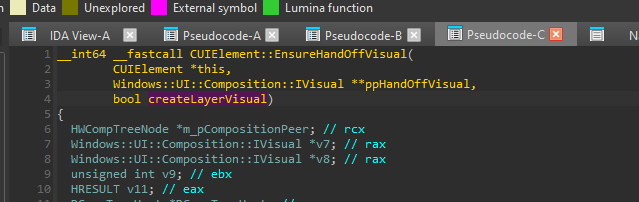
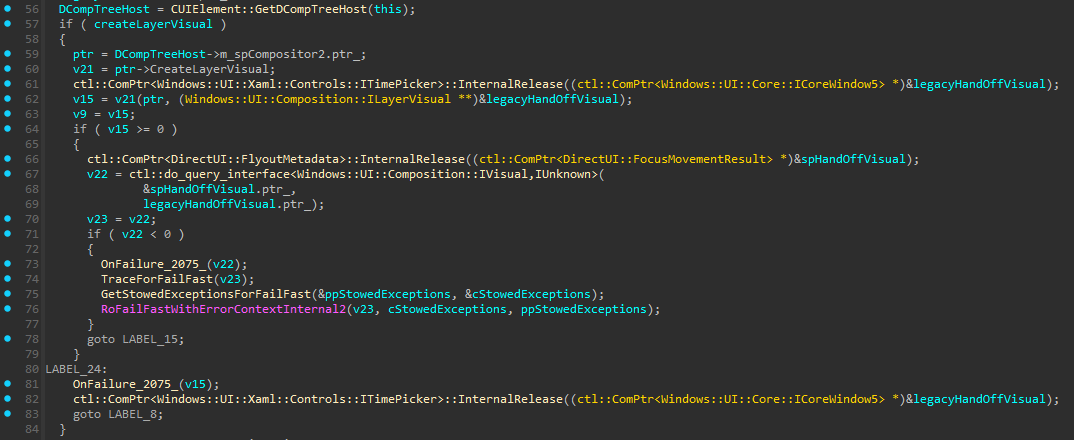
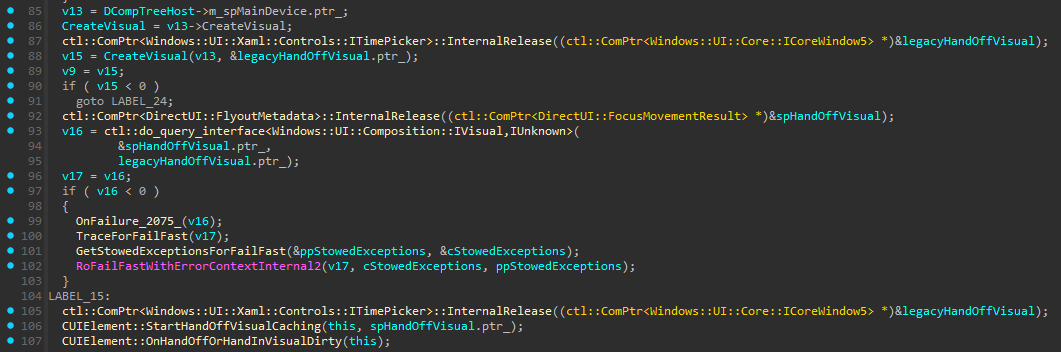
I was exploring XAML's [Handoff Visual](https://learn.microsoft.com/uwp/api/windows.ui.xaml.hosting.elementcompositionpreview.getelementvisual) implementation and how it's created, clipped, wrapped, etc... and found out that the function responsible for creating that visual is `CUIElement::EnsureHandOffVisual` and when I looked at this function I noticed that it has a `bool createLayerVisual` parameter:
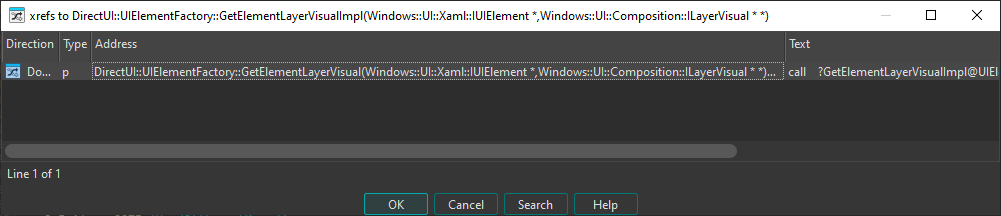
So I looked at the xrefs of this function to see if and when this parameter gets used, and noticed there's a function called `CUIElement::GetHandOffLayerVisual` in the xrefs:
So I was curious and checked the xrefs of it, and found a very interesting function, `DirectUI::UIElementFactory::GetElementLayerVisual`
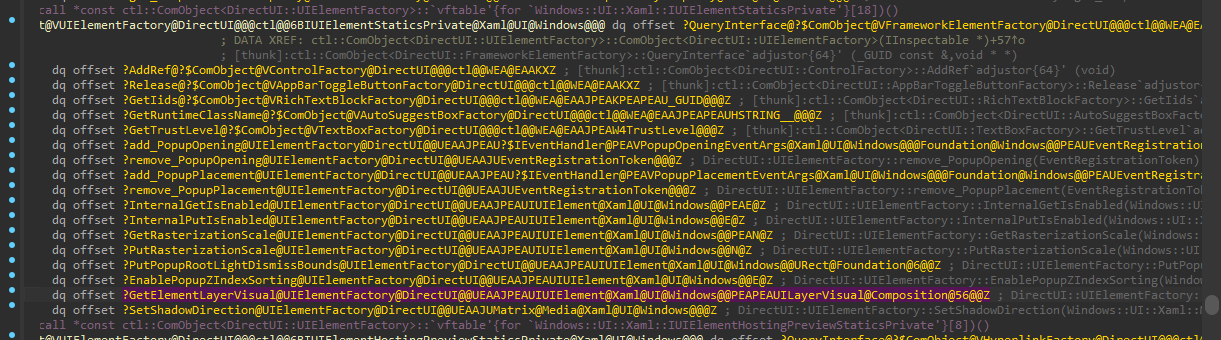
Stuff under the `DirectUI` namespace are usually exposed via interfaces, and that was the case here too!
Xrefs showed that it's exposed through the `Windows::UI::Xaml::IUIElementStaticsPrivate` interface:
I was curious when this was introduced since I have never seen it before, and after checking multiple **Windows.UI.Xaml.dll** versions, it turns out that it was introduced in **Windows 11 Build 22000**.
`LayerVisual` is a visual type that allows you to apply effects and attach shadows to its child visuals.
## **Experimentation**
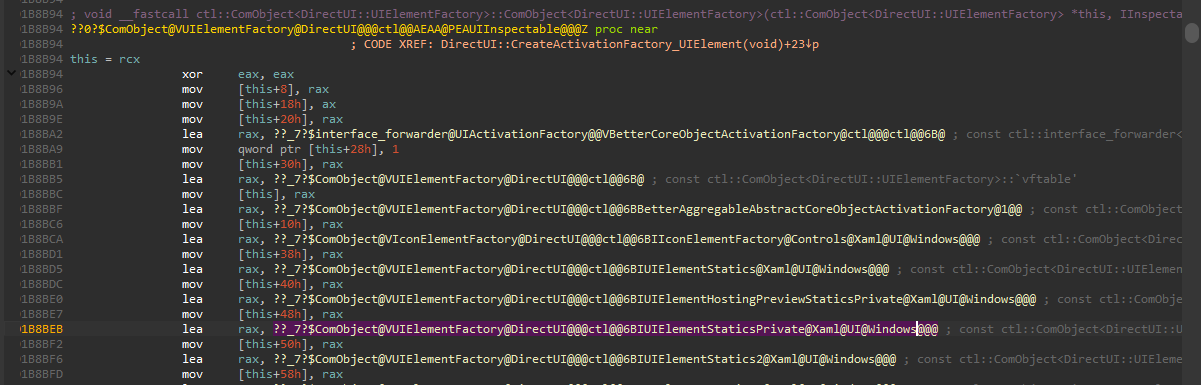
Now that we have the interface and the function signature, the only thing missing is the interface **IID**, checking the `UIElementFactory` constructor reveals that the interface is stored at offset **0x50** of the factory class object:
And if we look at the `QueryInterface` implementation, we can see that it wraps/calls another `QueryInterface` function but with a pointer to the object at offset **0x10** passed as a `this` parameter:
This means that we are looking for the **IID** of object returned at offset **0x40** ( **0x50 - 0x10** ) in that wrapped `QueryInterface` function.
If we look at that function we see that IDA mistyped the `this` parameter and also wasn't able to detect that it's the `this` parameter and showed it as a regular register variable:
To fix this mess, we will simply change the type of this variable to `void*`, this way we can see the offsets more clearly, and here we go, we found our **IID**!
We are using **UWP .NET 9** for this experiment so we have to use **Source Generated COM** to declare this interface definition (technically we can use a projection project or handroll the interface projection codegen too but this is simpler, well, *kinda*)
```csharp theme={null}
[GeneratedComInterface]
[InterfaceType(ComInterfaceType.InterfaceIsIUnknown)]
[Guid("7cc8cb07-5a0d-46bb-8c54-9beafe63b476")]
internal unsafe partial interface IUIElementStaticsPrivate
{
// IInspectable methods
void GetIids();
void GetRuntimeClassName();
void GetTrustLevel();
// IUIElementStaticsPrivate methods
void add_PopupOpening();
void remove_PopupOpening();
void add_PopupPlacement();
void remove_PopupPlacement();
void InternalGetIsEnabled();
void InternalPutIsEnabled();
void GetRasterizationScale();
void PutRasterizationScale();
void PutPopupRootLightDismissBounds();
void EnablePopupZIndexSorting();
void* GetElementLayerVisual(void* pElement);
}
```
Now we only need to write some test code and see if it works
```jsx theme={null}
```
```csharp expandable theme={null}
private void playButton_Click(object sender, RoutedEventArgs e)
{
// In CsWinRT 3, this probably needs to be changed to something like:
// using var objRef = WindowsRuntimeActivationFactory.GetActivationFactory(typeof(UIElement).FullName, typeof(IUIElementStaticsPrivate).GUID);
// var staticsPrivate = ComInterfaceMarshaller.ConvertToManaged(objRef.GetThisPtrUnsafe());
var staticsPrivate = UIElement.As();
// GetElementLayerVisual expects an IUIElement* but CsWinRT won't give us an IUIElement from a composed class (such as ContentControl) unless
// it's passed to a projected method that takes an UIElement, so we have to QI manually
Marshal.QueryInterface(((IWinRTObject)contentControl).NativeObject.ThisPtr, new("676d0be9-b65c-41c6-ba40-58cf87f201c1") /* IUIElement */, out nint ppv);
var layerVisualPtr = staticsPrivate.GetElementLayerVisual((void*)ppv);
Marshal.Release(ppv);
var layerVisual = LayerVisual.FromAbi((nint)layerVisualPtr);
var compositor = layerVisual.Compositor;
var blur = new GaussianBlurEffect
{
Name = "Blur",
BlurAmount = 0.0f,
BorderMode = EffectBorderMode.Soft,
Optimization = EffectOptimization.Balanced,
Source = new CompositionEffectSourceParameter("source")
};
var effectFactory = compositor.CreateEffectFactory(blur, new[] { "Blur.BlurAmount" });
var effectBrush = effectFactory.CreateBrush();
layerVisual.Effect = effectBrush;
var easing = CompositionEasingFunction.CreateExponentialEasingFunction(compositor, CompositionEasingFunctionMode.InOut, 6);
var animation = compositor.CreateScalarKeyFrameAnimation();
animation.InsertKeyFrame(0.0f, 0.0f, easing);
animation.InsertKeyFrame(1.0f, 10.0f, easing);
animation.Duration = TimeSpan.FromSeconds(2);
animation.IterationBehavior = AnimationIterationBehavior.Forever;
animation.Direction = AnimationDirection.Alternate;
effectBrush.StartAnimation("Blur.BlurAmount", animation);
Marshal.QueryInterface(((IWinRTObject)hiButton).NativeObject.ThisPtr, new("676d0be9-b65c-41c6-ba40-58cf87f201c1") /* IUIElement */, out nint ppv2);
var layerVisual2Ptr = staticsPrivate.GetElementLayerVisual((void*)ppv2);
Marshal.Release(ppv2);
var layerVisual2 = LayerVisual.FromAbi((nint)layerVisual2Ptr);
var alphaMask = new AlphaMaskEffect
{
Name = "AlphaMask",
Source = new CompositionEffectSourceParameter("source"),
AlphaMask = new CompositionEffectSourceParameter("mask")
};
var gradientBrush = compositor.CreateLinearGradientBrush();
gradientBrush.StartPoint = new(0, 0);
gradientBrush.EndPoint = new(1, 0);
gradientBrush.MappingMode = CompositionMappingMode.Relative;
CompositionColorGradientStop stop;
gradientBrush.ColorStops.Add(compositor.CreateColorGradientStop(-1.0f, Colors.Black));
gradientBrush.ColorStops.Add(stop = compositor.CreateColorGradientStop(1.0f, Colors.Black));
gradientBrush.ColorStops.Add(compositor.CreateColorGradientStop(1.0f, Colors.Transparent));
var easing2 = CompositionEasingFunction.CreatePowerEasingFunction(compositor, CompositionEasingFunctionMode.InOut, 3);
var animation2 = compositor.CreateScalarKeyFrameAnimation();
animation2.InsertKeyFrame(0.0f, 1.0f, easing2);
animation2.InsertKeyFrame(1.0f, -1.0f, easing2);
animation2.Duration = TimeSpan.FromSeconds(2);
animation2.IterationBehavior = AnimationIterationBehavior.Forever;
animation2.Direction = AnimationDirection.Alternate;
stop.StartAnimation("Offset", animation2);
var effectFactory2 = compositor.CreateEffectFactory(alphaMask);
var effectBrush2 = effectFactory2.CreateBrush();
effectBrush2.SetSourceParameter("mask", gradientBrush);
layerVisual2.Effect = effectBrush2;
}
```
*And voila!*
**Warning**
* `GetElementLayerVisual` has to be called **before** any handoff visual was created for the element, so if `ElementCompositionPreview.GetElementVisual` was called on the element prior it, the function will fail.
* If you are calling that method on an element that has any `Popup` children, you have to call `ElementCompositionPreview.GetElementVisual` on the element after calling `GetElementLayerVisual` or otherwise the `Popup` will break.
## **But what about Windows 10?**
This function we just used doesn't exist in the **Windows 10** version of that interface, but looking at how `createLayerVisual` is used inside `CUIElement::EnsureHandOffVisual` we can see that the `LayerVisual` and the normal visual paths are *very* similar, so similar that we can hook `IDCompositionDevice2::CreateVisual` and redirect it to `Windows.UI.Compositor.CreateLayerVisual` and it will just work.
We will be using a **C++/WinRT Runtime Component** for this since we are gonna need **Detours**, and using **Detours** in C# is a bit harder than using it from C++ directly.
So let's create a simple WinRT helper static class for this, lets start with the **IDL**:
```cpp theme={null}
namespace XamlCompositionHelpers
{
static runtimeclass ElementCompositionPreviewEx
{
static Windows.UI.Composition.LayerVisual GetElementLayerVisual(Windows.UI.Xaml.UIElement element);
}
}
```
And now the implementation:
```cpp expandable theme={null}
namespace winrt::XamlCompositionHelpers::implementation
{
bool ElementCompositionPreviewEx::s_Hooked = false;
DWORD ElementCompositionPreviewEx::s_ThreadId = NULL;
std::mutex ElementCompositionPreviewEx::s_Mutex = { };
decltype(ElementCompositionPreviewEx::s_CreateVisual) ElementCompositionPreviewEx::s_CreateVisual = nullptr;
decltype(ElementCompositionPreviewEx::s_QueryInterface) ElementCompositionPreviewEx::s_QueryInterface = nullptr;
static bool IsOnWindows11OrHigher()
{
bool isWin11 = ApiInformation::IsApiContractPresent(L"Windows.Foundation.UniversalApiContract", 14);
return isWin11;
}
LayerVisual ElementCompositionPreviewEx::GetElementLayerVisual(UIElement const& element)
{
// On Windows 11 b22000 and higher, we can use the IUIElementStaticsPrivate interface to get the LayerVisual directly
com_ptr uiElementPrivate;
if (IsOnWindows11OrHigher() && (uiElementPrivate = try_get_activation_factory()))
{
LayerVisual layerVisual { nullptr };
check_hresult(uiElementPrivate->GetElementLayerVisual(winrt::get_abi(element), put_abi(layerVisual)));
return layerVisual;
}
// We are using the thread ID to verify and ensure that we aren't hoking any other ElementCompositionPreview::GetElementVisual call
// that happened to be going in another thread at the same time we are hooking the function to return a LayerVisual,
// and we use a lock to ensure that only one thread can be hooking at a time so that thread ID doesn't get changed mid-hook.
std::scoped_lock lock(s_Mutex);
EnsureHooked();
s_ThreadId = GetCurrentThreadId();
auto visual = ElementCompositionPreview::GetElementVisual(element);
s_ThreadId = NULL;
return visual.as();
}
void ElementCompositionPreviewEx::EnsureHooked()
{
if (!s_Hooked)
{
// assuming we are on the UI thread, it wouldn't work otherwise anyway
auto compositor = Window::Current().Compositor();
auto device3 = compositor.as();
auto vtbl = *reinterpret_cast(device3.get());
s_CreateVisual = reinterpret_cast(vtbl[6]);
DetourTransactionBegin();
DetourUpdateThread(GetCurrentThread());
DetourAttach(&(PVOID&)s_CreateVisual, &ElementCompositionPreviewEx::CreateVisualHook);
check_win32(DetourTransactionCommit());
// some older Windows builds don't have the createLayerVisual parameter
// and on these builds XAML actually tries to use the visual as IDCompsitionVisual*
// which fails because LayerVisual is not an InteropVisual, we work around this
// by creating a dummy InteropVisual and hooking QI calls on the LayerVisual
// that query for IDCompsitionVisual* and redirect them to our dummy InteropVisual
check_hresult(device3->CreateVisual(&s_dummyVisual));
auto layerVisual = compositor.CreateLayerVisual().as();
auto layerVtbl = *reinterpret_cast(winrt::get_abi(layerVisual));
s_QueryInterface = reinterpret_cast(layerVtbl[0]);
DetourTransactionBegin();
DetourUpdateThread(GetCurrentThread());
DetourAttach(&(PVOID&)s_QueryInterface, &ElementCompositionPreviewEx::QueryInterfaceHook);
check_win32(DetourTransactionCommit());
s_Hooked = true;
}
}
HRESULT WINAPI ElementCompositionPreviewEx::CreateVisualHook(IDCompositionDevice2* pThis, IDCompositionVisual2** ppVisual)
{
// Ensure that we are only hooking our own calls to ElementCompositionPreview::GetElementVisual / IDCompositionDevice2::CreateVisual
if (s_ThreadId != GetCurrentThreadId())
return s_CreateVisual(pThis, ppVisual);
Compositor compositor { nullptr };
copy_from_abi(compositor, pThis);
LayerVisual layerVisual = compositor.CreateLayerVisual();
copy_to_abi(layerVisual, *(void**&)ppVisual);
return S_OK;
}
HRESULT WINAPI ElementCompositionPreviewEx::QueryInterfaceHook(IUnknown* pThis, REFIID riid, void** ppv)
{
const static auto xamlModule = GetModuleHandleW(L"Windows.UI.Xaml.dll");
static const constexpr auto IID1 = std::bit_cast(guid("1CD4B256-A5ED-4DED-A0C1-82A7A20B8755"));
static const constexpr auto IID2 = std::bit_cast(guid("86C82676-5D2A-4E6A-A89F-50A22FF86263"));
static const constexpr auto IID3 = std::bit_cast(guid("A0AD01B5-9C60-4A6F-A7E2-04E18CF5E011"));
LayerVisual layerVisual { nullptr };
HMODULE module = NULL;
HRESULT result = s_QueryInterface(pThis, riid, ppv);
if (FAILED(result) &&
s_dummyVisual &&
(riid == IID1 || riid == IID2 || riid == IID3) &&
GetModuleHandleExW(GET_MODULE_HANDLE_EX_FLAG_FROM_ADDRESS, (LPCWSTR)_ReturnAddress(), &module) &&
module == xamlModule &&
SUCCEEDED(s_QueryInterface(pThis, winrt::guid_of(), winrt::put_abi(layerVisual))))
{
result = s_dummyVisual->QueryInterface(riid, ppv);
}
return result;
}
}
```
And with this we can then replace our C# code with this:
```csharp expandable theme={null}
private void playButton_Click(object sender, RoutedEventArgs e)
{
var layerVisual = ElementCompositionPreviewEx.GetElementLayerVisual(contentControl);
var compositor = layerVisual.Compositor;
var blur = new GaussianBlurEffect
{
Name = "Blur",
BlurAmount = 0.0f,
BorderMode = EffectBorderMode.Soft,
Optimization = EffectOptimization.Balanced,
Source = new CompositionEffectSourceParameter("source")
};
var effectFactory = compositor.CreateEffectFactory(blur, new[] { "Blur.BlurAmount" });
var effectBrush = effectFactory.CreateBrush();
layerVisual.Effect = effectBrush;
var easing = CompositionEasingFunctionEx.CreateExponentialEasingFunction(compositor, CompositionEasingFunctionMode.InOut, 6);
var animation = compositor.CreateScalarKeyFrameAnimation();
animation.InsertKeyFrame(0.0f, 0.0f, easing);
animation.InsertKeyFrame(1.0f, 10.0f, easing);
animation.Duration = TimeSpan.FromSeconds(2);
animation.IterationBehavior = AnimationIterationBehavior.Forever;
animation.Direction = AnimationDirection.Alternate;
effectBrush.StartAnimation("Blur.BlurAmount", animation);
var layerVisual2 = ElementCompositionPreviewEx.GetElementLayerVisual(hiButton);
var alphaMask = new AlphaMaskEffect
{
Name = "AlphaMask",
Source = new CompositionEffectSourceParameter("source"),
AlphaMask = new CompositionEffectSourceParameter("mask")
};
var gradientBrush = compositor.CreateLinearGradientBrush();
gradientBrush.StartPoint = new(0, 0);
gradientBrush.EndPoint = new(1, 0);
gradientBrush.MappingMode = CompositionMappingMode.Relative;
CompositionColorGradientStop stop;
gradientBrush.ColorStops.Add(compositor.CreateColorGradientStop(-1.0f, Colors.Black));
gradientBrush.ColorStops.Add(stop = compositor.CreateColorGradientStop(1.0f, Colors.Black));
gradientBrush.ColorStops.Add(compositor.CreateColorGradientStop(1.0f, Colors.Transparent));
var easing2 = CompositionEasingFunctionEx.CreatePowerEasingFunction(compositor, CompositionEasingFunctionMode.InOut, 3);
var animation2 = compositor.CreateScalarKeyFrameAnimation();
animation2.InsertKeyFrame(0.0f, 1.0f, easing2);
animation2.InsertKeyFrame(1.0f, -1.0f, easing2);
animation2.Duration = TimeSpan.FromSeconds(2);
animation2.IterationBehavior = AnimationIterationBehavior.Forever;
animation2.Direction = AnimationDirection.Alternate;
stop.StartAnimation("Offset", animation2);
var effectFactory2 = compositor.CreateEffectFactory(alphaMask);
var effectBrush2 = effectFactory2.CreateBrush();
effectBrush2.SetSourceParameter("mask", gradientBrush);
layerVisual2.Effect = effectBrush2;
}
```
*And voila!*
As you might have noticed I'm using `CompositionEasingFunctionEx` instead of `CompositionEasingFunction` to create easing functions in the \*\*Windows 10 \*\*code, that's because the latter only got the support for creating easing functions in **Windows 11**, so I created a `CompositionEasingFunctionEx` helper class to allow creating such easing functions under **Windows 10**, but that's a story for another article.
## **But what about WinUI 3?**
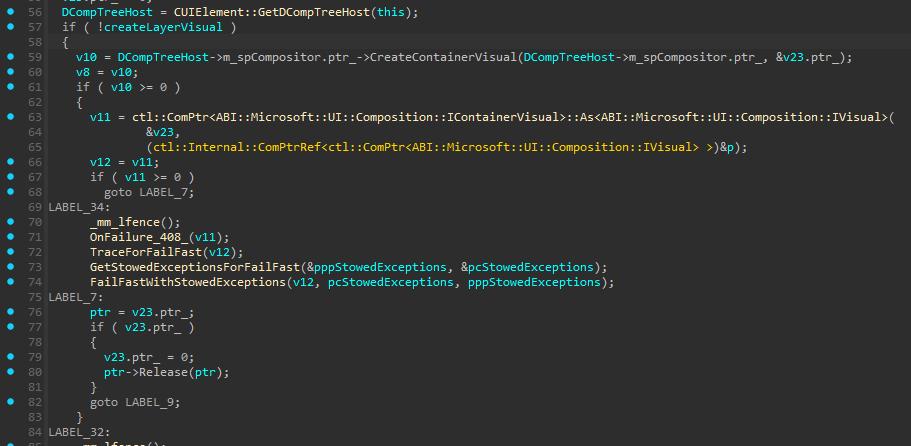
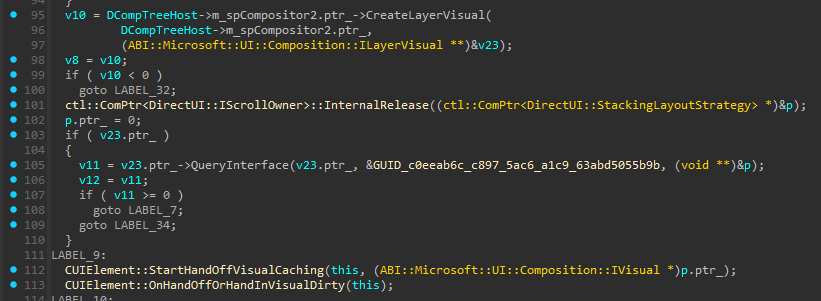
Unfortunately WinUI 3 doesn't have that interface method at all, neither in latest version or older ones, \*\*BUT \*\*we can use the same trick we used for **Windows 10**, so lets take a look at the `CUIElement::EnsureHandOffVisual` function in **WinUI 3**:
Interesting, so it uses the WinRT `Microsoft.UI.Composition` API for both cases, so we need to copy the C++ implementation code we wrote before and make few changes to accommodate that (previous comments are omitted, so check them in the UWP/WUX code if you haven't)
```cpp expandable theme={null}
namespace winrt::WinUICompositionHelpers::implementation
{
bool ElementCompositionPreviewEx::s_Hooked = false;
DWORD ElementCompositionPreviewEx::s_ThreadId = NULL;
std::mutex ElementCompositionPreviewEx::s_Mutex = { };
decltype(ElementCompositionPreviewEx::s_CreateContainerVisual) ElementCompositionPreviewEx::s_CreateContainerVisual = nullptr;
LayerVisual ElementCompositionPreviewEx::GetElementLayerVisual(UIElement const& element)
{
std::scoped_lock lock(s_Mutex);
assert(element.DispatcherQueue().HasThreadAccess());
EnsureHooked(CompositionTarget::GetCompositorForCurrentThread());
s_ThreadId = GetCurrentThreadId();
auto visual = ElementCompositionPreview::GetElementVisual(element);
s_ThreadId = NULL;
return visual.as();
}
void ElementCompositionPreviewEx::EnsureHooked(Compositor compositor)
{
if (!s_Hooked)
{
auto vtbl = *reinterpret_cast(winrt::get_abi(compositor));
s_CreateContainerVisual = reinterpret_cast(vtbl[9]);
DetourTransactionBegin();
DetourUpdateThread(GetCurrentThread());
DetourAttach(&(PVOID&)s_CreateContainerVisual, &ElementCompositionPreviewEx::CreateContainerVisualHook);
check_win32(DetourTransactionCommit());
s_Hooked = true;
}
}
HRESULT WINAPI ElementCompositionPreviewEx::CreateContainerVisualHook(void* pThis, void** ppVisual)
{
if (s_ThreadId != GetCurrentThreadId())
return s_CreateContainerVisual(pThis, ppVisual);
Compositor compositor { nullptr };
copy_from_abi(compositor, pThis);
LayerVisual layerVisual = compositor.CreateLayerVisual();
copy_to_abi(layerVisual, *(void**&)ppVisual);
return S_OK;
}
}
```
The C# code is the same as UWP/WUX version, so no need to include it again, and with that in place.... *voila!*
And that's it, see you in the next article!
## **Update**
I accidentally found a better and easier way to achieve this without hooking or any complex stuff at all while working on another thing.
So basically I found out that `CompositionVisualSurface` completely ignores the `Opacity` property of the source Visual, so you can just get the Visual of the target `UIElement`, make its `Opacity` **0**, then create a `CompositionSurfaceBrush` over a `CompositionVisualSurface` of the Visual then use that to create a `SpriteVisual` with `CompositionEffectBrush` or `CompositionMaskBrush` (with the source brush set to the `CompositionSurfaceBrush`) on top of it!
*Special thanks to* [*Dongle*](https://x.com/a_donglee) *for proofreading the article*
 So I looked at the xrefs of this function to see if and when this parameter gets used, and noticed there's a function called `CUIElement::GetHandOffLayerVisual` in the xrefs:
 So I was curious and checked the xrefs of it, and found a very interesting function, `DirectUI::UIElementFactory::GetElementLayerVisual`

 Stuff under the `DirectUI` namespace are usually exposed via interfaces, and that was the case here too!
Xrefs showed that it's exposed through the `Windows::UI::Xaml::IUIElementStaticsPrivate` interface:
Stuff under the `DirectUI` namespace are usually exposed via interfaces, and that was the case here too!
Xrefs showed that it's exposed through the `Windows::UI::Xaml::IUIElementStaticsPrivate` interface:
 I was curious when this was introduced since I have never seen it before, and after checking multiple **Windows.UI.Xaml.dll** versions, it turns out that it was introduced in **Windows 11 Build 22000**.
 And if we look at the `QueryInterface` implementation, we can see that it wraps/calls another `QueryInterface` function but with a pointer to the object at offset **0x10** passed as a `this` parameter:
 This means that we are looking for the **IID** of object returned at offset **0x40** ( **0x50 - 0x10** ) in that wrapped `QueryInterface` function.
If we look at that function we see that IDA mistyped the `this` parameter and also wasn't able to detect that it's the `this` parameter and showed it as a regular register variable:
This means that we are looking for the **IID** of object returned at offset **0x40** ( **0x50 - 0x10** ) in that wrapped `QueryInterface` function.
If we look at that function we see that IDA mistyped the `this` parameter and also wasn't able to detect that it's the `this` parameter and showed it as a regular register variable:
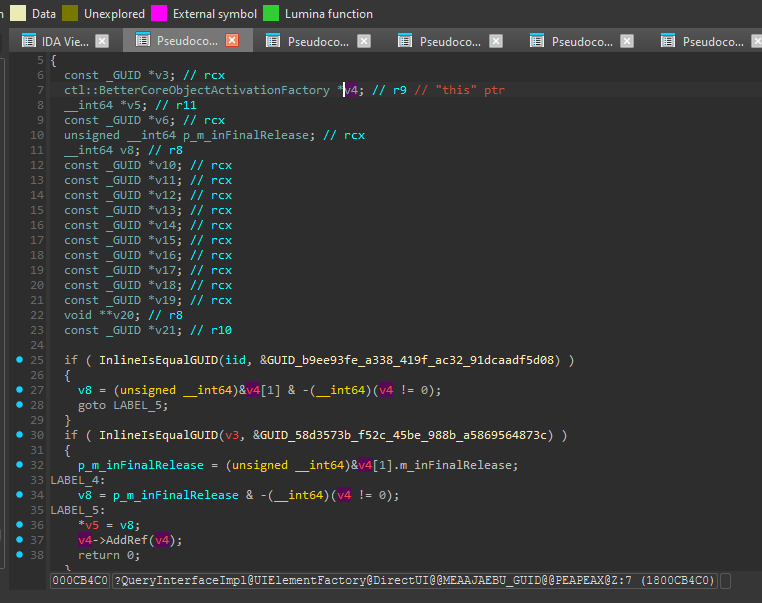 To fix this mess, we will simply change the type of this variable to `void*`, this way we can see the offsets more clearly, and here we go, we found our **IID**!
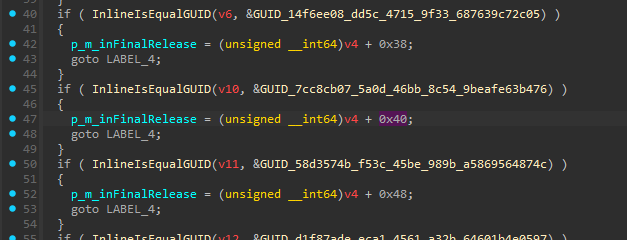 We are using **UWP .NET 9** for this experiment so we have to use **Source Generated COM** to declare this interface definition (technically we can use a projection project or handroll the interface projection codegen too but this is simpler, well, *kinda*)
```csharp theme={null}
[GeneratedComInterface]
[InterfaceType(ComInterfaceType.InterfaceIsIUnknown)]
[Guid("7cc8cb07-5a0d-46bb-8c54-9beafe63b476")]
internal unsafe partial interface IUIElementStaticsPrivate
{
// IInspectable methods
void GetIids();
void GetRuntimeClassName();
void GetTrustLevel();
// IUIElementStaticsPrivate methods
void add_PopupOpening();
void remove_PopupOpening();
void add_PopupPlacement();
void remove_PopupPlacement();
void InternalGetIsEnabled();
void InternalPutIsEnabled();
void GetRasterizationScale();
void PutRasterizationScale();
void PutPopupRootLightDismissBounds();
void EnablePopupZIndexSorting();
void* GetElementLayerVisual(void* pElement);
}
```
Now we only need to write some test code and see if it works
```jsx theme={null}
We are using **UWP .NET 9** for this experiment so we have to use **Source Generated COM** to declare this interface definition (technically we can use a projection project or handroll the interface projection codegen too but this is simpler, well, *kinda*)
```csharp theme={null}
[GeneratedComInterface]
[InterfaceType(ComInterfaceType.InterfaceIsIUnknown)]
[Guid("7cc8cb07-5a0d-46bb-8c54-9beafe63b476")]
internal unsafe partial interface IUIElementStaticsPrivate
{
// IInspectable methods
void GetIids();
void GetRuntimeClassName();
void GetTrustLevel();
// IUIElementStaticsPrivate methods
void add_PopupOpening();
void remove_PopupOpening();
void add_PopupPlacement();
void remove_PopupPlacement();
void InternalGetIsEnabled();
void InternalPutIsEnabled();
void GetRasterizationScale();
void PutRasterizationScale();
void PutPopupRootLightDismissBounds();
void EnablePopupZIndexSorting();
void* GetElementLayerVisual(void* pElement);
}
```
Now we only need to write some test code and see if it works
```jsx theme={null}
 We will be using a **C++/WinRT Runtime Component** for this since we are gonna need **Detours**, and using **Detours** in C# is a bit harder than using it from C++ directly.
So let's create a simple WinRT helper static class for this, lets start with the **IDL**:
```cpp theme={null}
namespace XamlCompositionHelpers
{
static runtimeclass ElementCompositionPreviewEx
{
static Windows.UI.Composition.LayerVisual GetElementLayerVisual(Windows.UI.Xaml.UIElement element);
}
}
```
And now the implementation:
```cpp expandable theme={null}
namespace winrt::XamlCompositionHelpers::implementation
{
bool ElementCompositionPreviewEx::s_Hooked = false;
DWORD ElementCompositionPreviewEx::s_ThreadId = NULL;
std::mutex ElementCompositionPreviewEx::s_Mutex = { };
decltype(ElementCompositionPreviewEx::s_CreateVisual) ElementCompositionPreviewEx::s_CreateVisual = nullptr;
decltype(ElementCompositionPreviewEx::s_QueryInterface) ElementCompositionPreviewEx::s_QueryInterface = nullptr;
static bool IsOnWindows11OrHigher()
{
bool isWin11 = ApiInformation::IsApiContractPresent(L"Windows.Foundation.UniversalApiContract", 14);
return isWin11;
}
LayerVisual ElementCompositionPreviewEx::GetElementLayerVisual(UIElement const& element)
{
// On Windows 11 b22000 and higher, we can use the IUIElementStaticsPrivate interface to get the LayerVisual directly
com_ptr
We will be using a **C++/WinRT Runtime Component** for this since we are gonna need **Detours**, and using **Detours** in C# is a bit harder than using it from C++ directly.
So let's create a simple WinRT helper static class for this, lets start with the **IDL**:
```cpp theme={null}
namespace XamlCompositionHelpers
{
static runtimeclass ElementCompositionPreviewEx
{
static Windows.UI.Composition.LayerVisual GetElementLayerVisual(Windows.UI.Xaml.UIElement element);
}
}
```
And now the implementation:
```cpp expandable theme={null}
namespace winrt::XamlCompositionHelpers::implementation
{
bool ElementCompositionPreviewEx::s_Hooked = false;
DWORD ElementCompositionPreviewEx::s_ThreadId = NULL;
std::mutex ElementCompositionPreviewEx::s_Mutex = { };
decltype(ElementCompositionPreviewEx::s_CreateVisual) ElementCompositionPreviewEx::s_CreateVisual = nullptr;
decltype(ElementCompositionPreviewEx::s_QueryInterface) ElementCompositionPreviewEx::s_QueryInterface = nullptr;
static bool IsOnWindows11OrHigher()
{
bool isWin11 = ApiInformation::IsApiContractPresent(L"Windows.Foundation.UniversalApiContract", 14);
return isWin11;
}
LayerVisual ElementCompositionPreviewEx::GetElementLayerVisual(UIElement const& element)
{
// On Windows 11 b22000 and higher, we can use the IUIElementStaticsPrivate interface to get the LayerVisual directly
com_ptr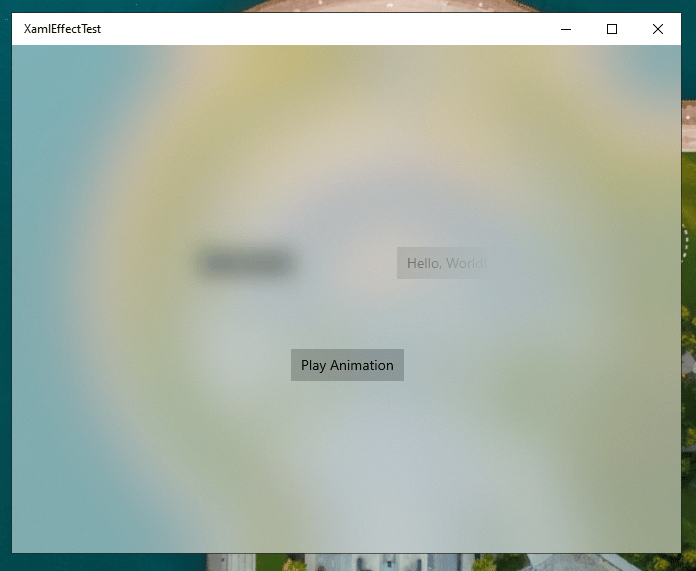
 Interesting, so it uses the WinRT `Microsoft.UI.Composition` API for both cases, so we need to copy the C++ implementation code we wrote before and make few changes to accommodate that (previous comments are omitted, so check them in the UWP/WUX code if you haven't)
```cpp expandable theme={null}
namespace winrt::WinUICompositionHelpers::implementation
{
bool ElementCompositionPreviewEx::s_Hooked = false;
DWORD ElementCompositionPreviewEx::s_ThreadId = NULL;
std::mutex ElementCompositionPreviewEx::s_Mutex = { };
decltype(ElementCompositionPreviewEx::s_CreateContainerVisual) ElementCompositionPreviewEx::s_CreateContainerVisual = nullptr;
LayerVisual ElementCompositionPreviewEx::GetElementLayerVisual(UIElement const& element)
{
std::scoped_lock lock(s_Mutex);
assert(element.DispatcherQueue().HasThreadAccess());
EnsureHooked(CompositionTarget::GetCompositorForCurrentThread());
s_ThreadId = GetCurrentThreadId();
auto visual = ElementCompositionPreview::GetElementVisual(element);
s_ThreadId = NULL;
return visual.as
Interesting, so it uses the WinRT `Microsoft.UI.Composition` API for both cases, so we need to copy the C++ implementation code we wrote before and make few changes to accommodate that (previous comments are omitted, so check them in the UWP/WUX code if you haven't)
```cpp expandable theme={null}
namespace winrt::WinUICompositionHelpers::implementation
{
bool ElementCompositionPreviewEx::s_Hooked = false;
DWORD ElementCompositionPreviewEx::s_ThreadId = NULL;
std::mutex ElementCompositionPreviewEx::s_Mutex = { };
decltype(ElementCompositionPreviewEx::s_CreateContainerVisual) ElementCompositionPreviewEx::s_CreateContainerVisual = nullptr;
LayerVisual ElementCompositionPreviewEx::GetElementLayerVisual(UIElement const& element)
{
std::scoped_lock lock(s_Mutex);
assert(element.DispatcherQueue().HasThreadAccess());
EnsureHooked(CompositionTarget::GetCompositorForCurrentThread());
s_ThreadId = GetCurrentThreadId();
auto visual = ElementCompositionPreview::GetElementVisual(element);
s_ThreadId = NULL;
return visual.as